

Some Thoughts on Failure from Mr. Cavanaugh
With another school year beginning, I have been thinking about something that may sound a little strange coming from someone who has spent most of his life teaching children:
Sometimes our children need to fail.
As parents, grandparents, teachers, and coaches, our natural instinct is to protect children. We don’t want to see them disappointed. We don’t want to see them struggle. And when they work hard at something, we certainly don’t want to see them fail.
I understand that. I’m a parent, too. But after teaching Taekwon-Do for over 40 years, I have come to believe that one of the greatest gifts we can give a child is not protection from every failure, but the ability to handle failure and come back from it.
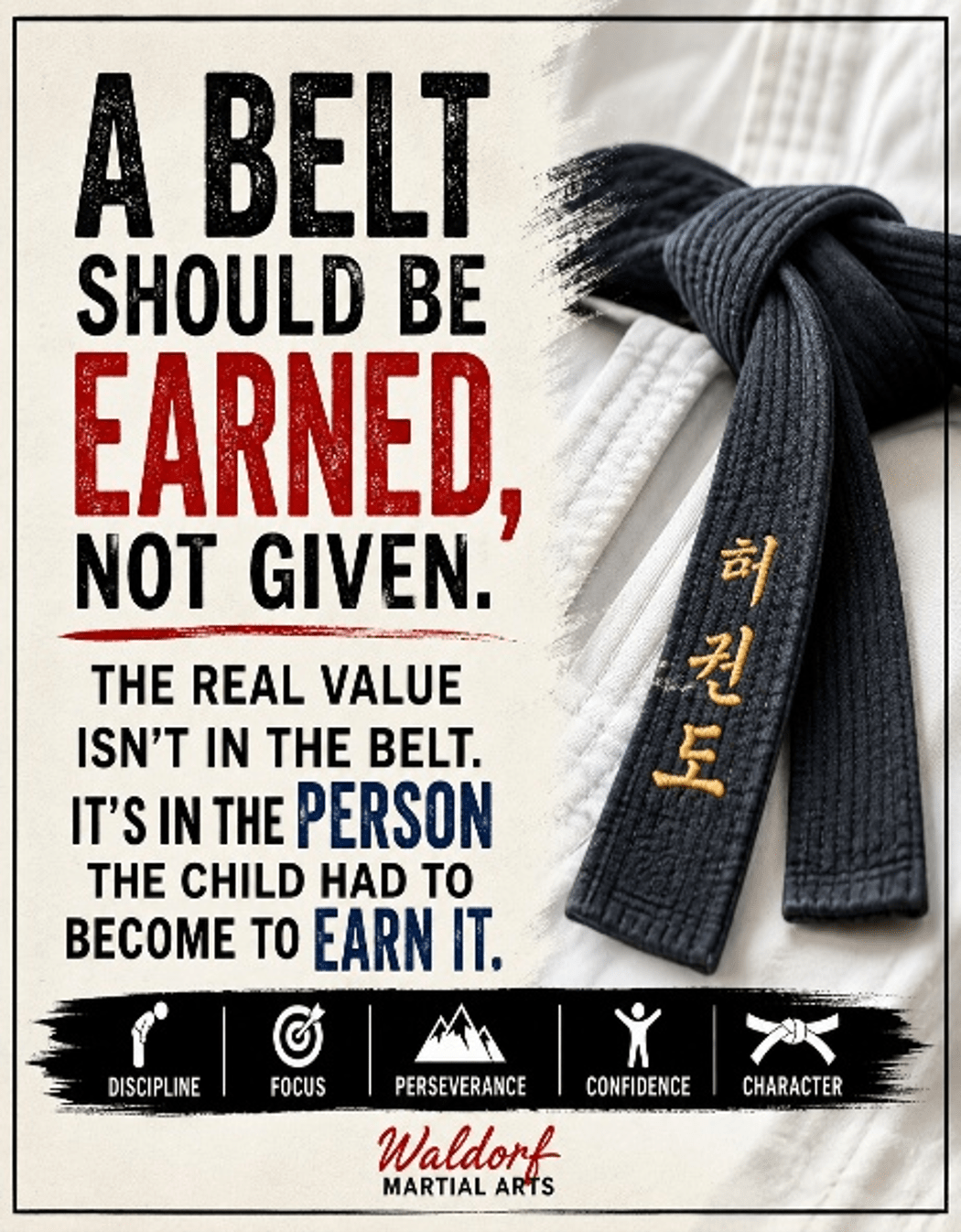
A Belt Should Be Earned
Every so often at belt testing, we have to give a student what we call a “no change.” It means the student is not being promoted to the next belt at that particular testing. I hate doing it.
I know the child is disappointed. I know Mom and Dad may be disappointed. And believe me, the instructors making that decision don’t enjoy it either. But there is something important that we cannot forget:
A belt that is simply given has very little value. A belt that is earned means something.
When we tie a new belt around a student’s waist, we are telling that student, “You have demonstrated that you are ready for the next level.” If we give the belt simply because a child showed up, because we don’t want to hurt their feelings, or because we don’t want a parent to be disappointed, what lesson have we taught? More importantly, what happens later in life when simply showing up isn’t enough?
“Not Yet” Is Not the Same as “Never”
I think adults sometimes hear the word failure differently than children need to hear it. Failing at something doesn’t mean: “I’m a failure.” It means: “I haven’t succeeded yet.”
There is a tremendous difference between those two statements.
A child who doesn’t earn the next belt has a choice. They can quit because they’re disappointed, or they can go back into class, practice what gave them trouble, listen to their instructors, work a little harder, and try again.
When that child eventually stands in front of us and successfully performs what they couldn’t do before, something much more important has happened than earning another colored belt. That child has learned:
“I can struggle with something and not give up.”
“I can be disappointed and still keep going.”
“I can fail, learn from it, and come back stronger.”
And finally: “I did it!”
Now that’s confidence! Not confidence that somebody gave them. Confidence they earned.
“The More You Fail, the Faster You’ll Succeed”
I’ve often said that the more you fail, the faster you’ll succeed. That doesn’t mean we should want our children to fail. It means we shouldn’t teach them to be afraid of failure.
Every mistake tells us something. Every unsuccessful attempt gives us information we didn’t have before. Every time we get knocked down and get back up, getting back up becomes a little easier.
That’s true when learning a Taekwon-Do form. It’s true when learning multiplication. It’s true when trying out for a school team, learning a musical instrument, applying to college, interviewing for a job, starting a business, or dealing with the hundreds of challenges life eventually puts in front of us.
The lesson is the same: Try. Fail. Learn. Adjust. Try again.
Eventually, succeed!
As This School Year Begins… Our children are going to face challenges this year. There will be difficult assignments. There may be disappointing grades. There will be friendships that don’t always go smoothly. Some will try out for teams and not make them. Others may struggle with subjects that seem to come easily to their classmates.
Our instinct may be to rush in and fix every problem. Sometimes we should. But sometimes the better question is: “What can my child learn by working through this?” There is nothing wrong with a child being disappointed. There is nothing wrong with struggling. And there is certainly nothing wrong with failing at something.
The important thing is what happens next. Do they give up? Or do they take a breath, figure out what went wrong, get some help, practice, and try again?
That’s one of the reasons I still believe so strongly in traditional martial arts training. Yes, we teach children how to kick, punch, block, spar, and defend themselves. But those aren’t necessarily the lessons that will matter most when they’re 30, 40, or 50 years old. I have former students stop by to visit (sometimes many years later) quite often. They always tell me of how they still use the lessons learned here, lessons about working hard, not giving up… even when you fail, staying positive, respectful, empathetic, and confident.
These lessons that stay with them teach life skills like perseverance, self-control, discipline, courage, and the understanding that something worth having is worth working for.
Someday, that colored belt may be sitting forgotten in a box. But the lesson the child learned while earning it may still be with them.
A belt should be earned, not given.
Because the real value isn’t in the belt.
It’s in the person the child had to become to earn it.
— Mr. Cavanaugh
Waldorf Martial Arts
“Failure isn’t the opposite of success. It’s part of the process that gets you there. The more willing you are to fail, learn, adjust, and try again, the faster you’ll eventually succeed.”
That’s what a “no change” should mean. Not “you failed.” It means “you’re not there yet.”
A College Essay Composed by One of Our Students.
by Jordan R.
“Courtesy, Integrity, Perseverance, Self-Control, Indomitable Spirit
I will respect my seniors and instructors, my parents and my fellow students. I will never misuse Taekwondo. I will be a champion of freedom and justice.
I will build a more peaceful world.”
This is something I have said more times than I can count to. When you are seven years old repeating this over and over again, it really doesn’t have much meaning to you. Now almost 10 years later, I understand the true meaning of Taekwondo. It was never just a sport to me, it was a family, an escape, a learning experience.
Most kids never really ask to be put into Taekwondo, since unlike tradition sports (soccer, football, volleyball, lacrosse, etc.) it’s year-round and not seasonal. This is a huge commitment. Some kids want to sign up because they want to learn how to kick and punch. Yes, I was “that” kid. I loved being that girl that knew how to defend herself. Little did I know as the Cavanaugh’s were teaching me how to “kick and punch” they were also teaching me to believe in myself, to be a leader, and to never give up. These are all important qualities of a martial arts athlete, but more importantly these are important qualities any successful person will need in life. They never really told me, “Hey Jordan, were setting you up to be successful, were teaching you right from wrong in a way that’s fun to you.” But that’s exactly what they did.
After becoming a 3-time AAU National Point Fighting Champion and receiving my black belt, I will be the first person to tell you Taekwondo is not just a sport, it’s a way of life. I was raised in an atmosphere that was unlike any other. I trained 4 to 5 days a week around people that I considered family. We all pushed each other and never gave up. We had difficult times, and enjoyable times. Man, it really was the life. Literally, because that’s what life’s all about, getting through the rough times to enjoy the good times.
Learning qualities like time management, determination, never give up until you reach your goals, at such a young age was very important. It taught me how to apply myself all throughout high school. It taught me how to manage my time wisely, and what a student athlete means. Being a student athlete means the student part comes first, my grades and being involved were always a big deal to me. I maintained a 3.0 accumulative GPA, as well as lettering in volleyball, and lacrosse. This is something I take much pride in. I spent time assisting in taekwondo classes. Not only were they teaching me martial arts, but teaching me to give back to my sport, and my community. I felt that in my studies of martial arts that I could help others grow as individuals as well. I also spent some time volunteering in the community as well as around my school. I spent time on my weekends going to Saint Peters Catholic Church working the food pantry with my grandparents. I was involved in other sports around my school, doing the announcements of soccer games, and stats to wrestling matches. I volunteered at my school’s mulch sales fund raiser. It has been important to me to always be involved in my school and in my community.
Taking a seven-year-old child and transforming her into a confident 17-year-old is what taekwondo did to me. It made me who I am today, I wouldn’t be the confident, determined, and responsible girl I am without it. What I learned 10 years ago, I am still applying to my everyday life. In martial arts they say getting your black belt is just the beginning and that’s how I see graduating high school graduation. It’s just the beginning for me.
“The more I learn, the more I realize how much more I still must learn. Taekwondo is a lifelong journey” Jordan R. — Student
Click here to schedule a free consultation and introductory class to see if our martial arts program is right for your family! We invite you to come explore how our martial arts program can inspire your child to achieve great things. There’s no risk, no cost, no hassles; we guarantee your continued satisfaction.
Author: Senior Master Roger Cavanaugh, 8th Degree Black Belt, has studied martial arts since 1977, and has taught martial arts in Waldorf, MD, since 1987.