

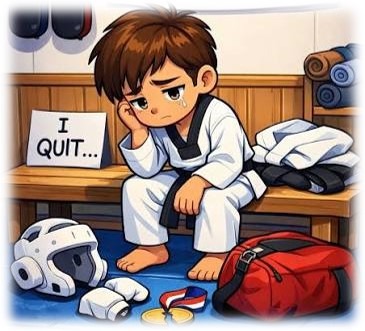
Recently, my wife and I received news that left us both disappointed and, quite frankly, a little dumbfounded. One of our young students, a Green Belt of about eight or nine years old, had decided to quit Taekwondo to pursue another activity. Now, children change interests. We understand that. Not every child who begins martial arts will become a Black Belt, and there are certainly legitimate reasons for leaving an activity.
But this particular situation bothered me because of how far this young man had come—and how far he still had to go. When he first walked through our doors, he was extremely timid. He rarely spoke more than a couple of words in class. His coordination was poor, and he had very little confidence in himself. But slowly, something began to change.
Week after week, class after class, belt after belt, we watched him grow. His physical skills improved. His coordination improved. He became more comfortable with the instructors and students around him. Most importantly, we began to see something developing that had been missing when he first arrived: Confidence.
Was he suddenly the most outgoing child in the school? No. Was our work finished? Not even close… But he was making progress. And that is precisely why hearing that he was quitting troubled me so much.
When Does Quitting Become a Lesson?
As parents, instructors, teachers, and coaches, we naturally want children to be happy. We want them to explore different interests and discover things they enjoy. But I believe we also have a responsibility to ask a more difficult question: Is quitting this activity really in the child’s best interest—or is quitting simply the easiest choice at the moment?
There is a tremendous difference between recognizing that something truly isn’t right for a child and allowing a child to walk away whenever something becomes difficult, repetitive, uncomfortable, or less exciting than the next new thing. Children don’t always understand the long-term purpose behind what adults ask them to do. That’s why parents make children go to school. That’s why we make them do homework. That’s why we expect them to brush their teeth, clean their rooms, eat something besides candy, and follow rules they may not particularly like.
We don’t always ask, “Do you feel like doing this today?” We make certain decisions because, as adults, we understand something children cannot yet fully appreciate: Growth often happens while doing things we don’t necessarily feel like doing. Confidence Isn’t Given. It Is Built.
One of the greatest misunderstandings about confidence is that people either have it or they don’t. Confidence is developed. A child builds confidence every time he accomplishes something he once believed he couldn’t do.
I couldn’t do that kick before—but now I can.
I couldn’t remember that form—but I practiced until I learned it.
I was afraid to stand in front of the class—but I did it.
I didn’t think I could earn my next belt—but I worked for it.
Those small victories accumulate. Eventually, the child begins saying something very powerful: “I can do this.” And after enough experiences, that becomes: “Maybe I can do other difficult things too.” That is one of the real purposes of martial arts training. The kicks, punches, blocks, forms, and self-defense techniques are important. But they are also tools we use to develop something much greater—the person performing them.
Sometimes the Child Who Wants to Quit Is the Child Who Most Needs to Continue! This is where parenting becomes difficult. A naturally confident, athletic child may move from one activity to another and adjust quickly. But what about the timid child? What about the child who struggles socially? What about the child who lacks coordination, gives up easily, is afraid of failure, or doesn’t believe in himself? Those may be the children who benefit most from staying with something long enough to experience genuine progress.
If we remove every obstacle, discomfort, disappointment, or difficult period from a child’s path, how will that child ever learn perseverance? A child cannot learn perseverance by hearing a lecture about perseverance. Perseverance must be practiced…
There will always be another activity that looks more exciting. There will always be days when practice isn’t fun. There will always be periods when progress seems slow. There will always be something new competing for our attention. Learning to continue anyway is part of growing up!
Martial Arts and Sports Can Both Build Children—But Differently. I have tremendous respect for athletics. Team and individual sports can teach discipline, teamwork, sportsmanship, physical fitness, perseverance, and how to handle both victory and defeat.
Martial arts can teach those lessons too, but it has an important difference. A child’s progress does not depend upon being selected for the starting lineup, being faster than another child, scoring more points, or helping a team win. The primary opponent is often the person in the mirror… Can you improve your balance? Can you remember your form? Can you control your emotions? Can you overcome your fear? Can you perform better today than you did yesterday? Can you keep going when something is difficult?
Competition exists in martial arts, and it can be extremely valuable. But competition does not have to be the reason a child trains. For many children—particularly those who lack confidence—that distinction can be enormously important. They have an opportunity to grow at their own pace while still being challenged.
Whenever a parent tells me that a child wants to quit, I think it is worth going back to the beginning. “Why did you enroll your child in the first place?” Was it because he needed confidence? Discipline? Focus? Physical fitness? Better coordination? Self-control? Respect? The ability to defend himself?
If the original problem has truly been addressed, then perhaps it makes sense to consider what comes next. But if the child is making progress and the original reason for enrolling still exists, we should think carefully before walking away from something that is working. The fact that a child has improved does not necessarily mean the training is no longer needed. Sometimes it means the training is doing exactly what you hoped it would do.
Not every activity must become a lifelong commitment. Circumstances change. Interests change. Families change. And there are absolutely times when leaving something is the correct decision. But I believe we should be careful about making quitting the automatic answer whenever a child becomes bored, frustrated, uncomfortable, or interested in something new. Because children are learning something from that decision. They may be learning:
“When something gets difficult, I can walk away.”
“When something new comes along, I don’t have to finish what I started.”
“If I don’t feel like doing something anymore, that’s enough reason to stop.”
Or we can help them learn something very different:
“I made a commitment.”
“This is difficult, but I can keep going.”
“I’m not good at this yet.”
“I don’t have to love every minute of something for it to be good for me.”
And perhaps most importantly: “I don’t quit simply because something is hard.”
Someday, the challenge won’t be Taekwondo. It may be school, College, A job, A marriage, Raising a family, Learning a new skill, Recovering from failure, Or pursuing a dream when success seems very far away.
We cannot remove those challenges from our children’s lives! But we can prepare them for those challenges. And sometimes preparation begins with something as simple as putting on a uniform, tying a belt around your waist, walking onto the training floor when you don’t particularly feel like it, and learning one of life’s most important lessons:
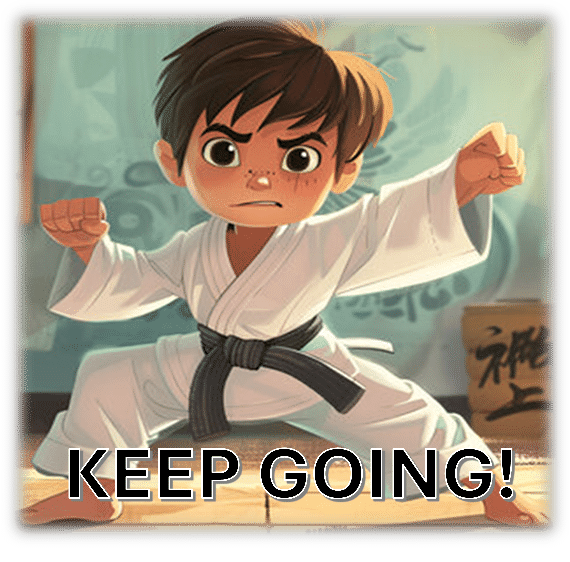
Keep going.
Schedule a free introductory lesson today to see the difference martial arts can make.
Your child’s future won’t be shaped by accident.
It will be shaped by what you decide to do next.
Let’s get to work!
Author: Senior Master Roger Cavanaugh, 8th Degree Black Belt, has studied martial arts since 1977, and has taught martial arts in Waldorf, MD, since 1987.
